


Londian’s HES System in China: The Backbone of Smart Grid Infrastructure
The Evolution of Energy Data Management in China
China accelerates its transition toward a digitalized and decarbonized energy landscape. The need for robust, scalable, and secure data management infrastructure has never been more critical. The Head End System (HES) has emerged as the foundational layer of modern Advanced Metering Infrastructure (AMI). It serves as the essential bridge between millions of smart meters and the utility enterprise systems. Those systems drive billing, analytics, and grid optimization. For system integrators, utility operators, and infrastructure developers HES systerm in China, understanding a high-performance HES’s capabilities is paramount.
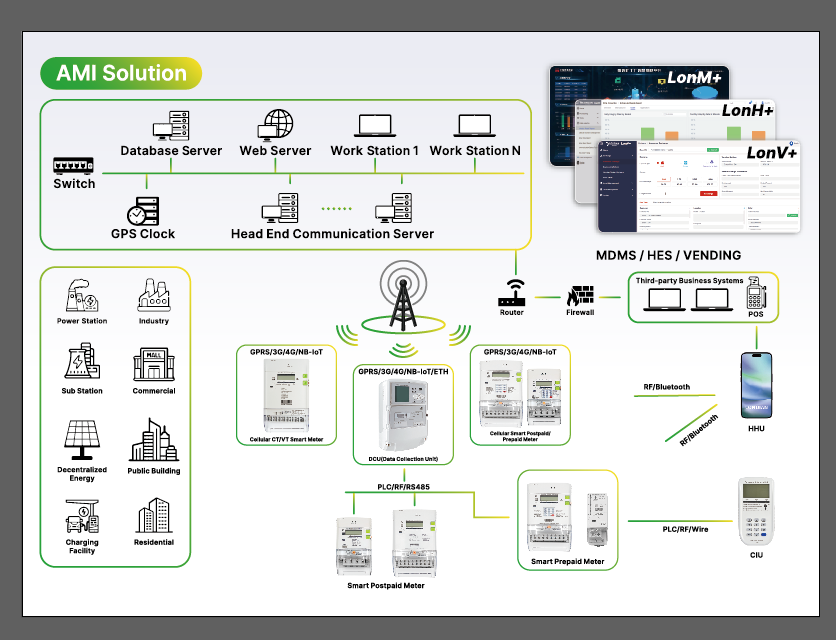
What Is a Head End System (HES)?
In smart metering and AMI, the Head End System functions as the central communication hub. It manages data collection, device configuration, and two-way communication with smart meters and Data Concentrator Units (DCUs). The HES acquires meter data on demand and at user-selectable intervals. It also maintains time synchronization with field devices. Moreover, it provides secure data encryption for communication channels. The HES stores raw meter data temporarily before making it available to Meter Data Management (MDM) systems. Those systems handle validation, estimation, editing (VEE), and billing processes.
A sophisticated HES goes beyond simple data collection. It enables remote firmware upgrades and parameter configuration. It also handles event and alarm logging and load management capabilities. For utilities deploying prepaid metering, the HES facilitates connection and disconnection commands. It also manages load curtailment limit settings and automated reconnection attempts. These functionalities transform the HES from a passive data collector into an active grid management tool.
The Chinese Context: Scale and Complexity
The Chinese smart grid market presents unique challenges. These challenges demand exceptional HES capabilities. Regional grid operators deploy over one million meters per utility. Those installations generate nearly 400 million data points daily. Therefore, the HES must exhibit extraordinary scalability and processing power. For example, a single provincial utility may process 38.4 million frozen values from 200,000 meters. It also handles additional data from hundreds of thousands more devices. All this requires reliable collection, validation, and forwarding.
Security requirements in the Chinese market are particularly stringent. HES systems must implement robust data communication encryption. They also require regular key updates. This protects against cyber threats. Furthermore, it ensures the integrity of revenue-critical billing data. Londian’s LonH+ HES addresses these demands through its open, universal architecture. This architecture supports integration with utility devices meeting international and regional standards.
Londian’s LonH+ Head End System
Londian has over 29 years of experience. The company has deployed more than 30 million meters worldwide. It developed the LonH+ HES as a comprehensive intelligent measuring instrument integration platform. The system supports multiple instrument vendors. It also enables seamless integration of intelligent measuring instruments. The platform adheres to international standards and protocols including DLMS/COSEM, IEC 62056-21, LoRaWAN, NB-IoT, and 4G/Cat-M.
LonH+ provides a robust communication and data services platform. It serves Meter Data Management (MDM), billing, Customer Information Systems (CIS), and mobile applications. Its open and universal nature allows integration with utility devices. Those devices meet international and regional standards. Consequently, this ensures compatibility and interoperability across diverse equipment ecosystems. For system integrators and OEM partners, this translates to reduced integration complexity. It also means faster time to market.
From Data Collection to Actionable Intelligence
The true value of a HES lies not in data collection alone. Instead, it enables downstream applications that drive operational efficiency and grid intelligence. Londian’s LonH+ feeds data to advanced analytics platforms. These platforms support line loss analysis and load management. They also handle theft detection and billing accuracy improvement. In China’s push toward a “Generation-Grid-Load-Storage” ecosystem, the HES serves as the critical data backbone. It enables bidirectional communication and renewable integration. It also supports real-time grid responsiveness.
A Strategic Partner for System Integration
Londian distinguishes itself as a Systems & Solutions OEM Manufacturer. It bridges the gap between hardware precision and software intelligence. The company has an R&D team of over 100 engineers. It also operates a 50,000+ square meter manufacturing facility. This facility features automated production lines and AI-driven quality control. The company offers a comprehensive ecosystem rather than isolated components. For utilities and system integrators seeking to deploy or upgrade AMI infrastructure in China, Londian’s LonH+ HES represents a proven, scalable, and secure solution. It is ready to meet the demands of the world’s largest smart grid market.